Workshop noteAugustin Matei15 October 20263 min read
Four layers, and a day of waiting between them
The depth of a dial does not come from the pigment, but from the time between layers. Why the fourth layer changes everything, and why the fifth sometimes ruins it.
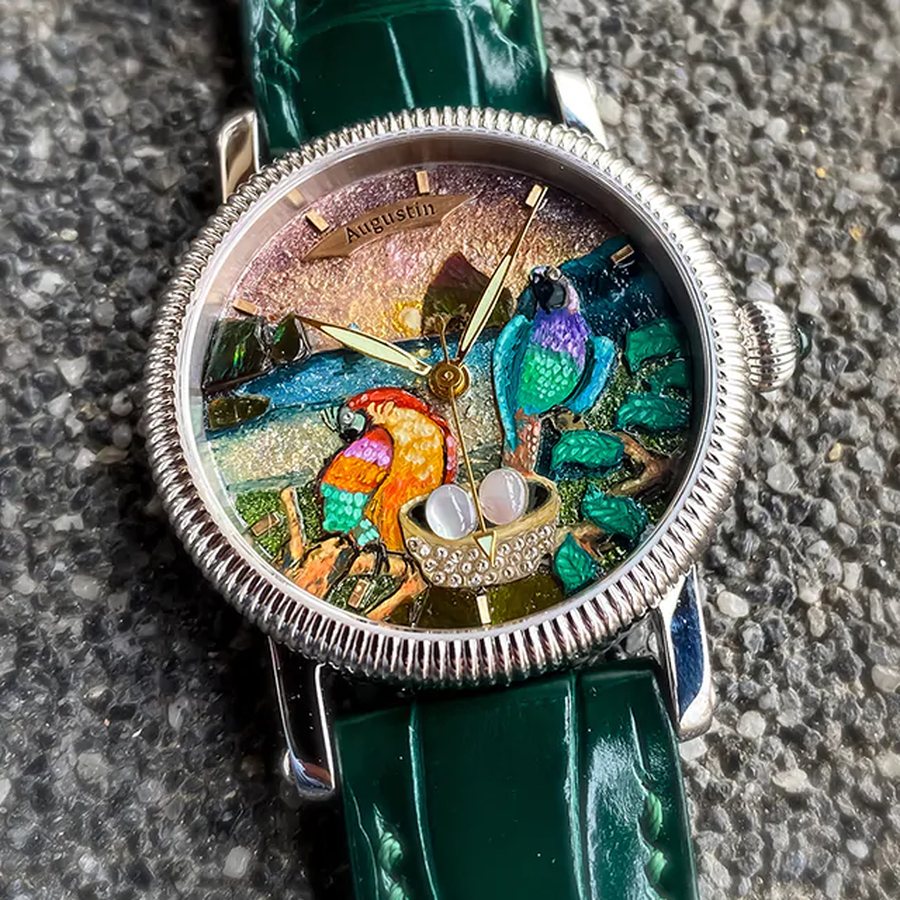
Colour on a dial is not applied, it is built. The difference sounds like vocabulary and is not.
A layer of pigment laid on thickly gives a flat surface, however good the pigment. Light goes in, strikes the metal ground and comes back by the same road. The eye reads a coloured patch.
Four thin layers, each dried completely before the next, do something else. Light enters through the first, returns in part, passes through the second, returns again. Each layer holds a little back and lets the rest travel on. What is seen at the surface is not the colour of the pigment, but the sum of the journeys light has made through it.
Why it cannot go faster
A layer that feels dry to the touch is not dry. The bonds go on forming for hours after the surface stops being tacky. A new layer laid on then sinks into the one beneath; the two mix at the boundary, and the boundary was exactly where the depth was being born.
The result is not a visible mistake. It is an absence: the dial looks right and yet flat, and the explanation does not show in a photograph.
The fifth layer
Depth increases up to a point, then falls. After the fourth layer, each new addition begins to steal light rather than return it: the layer on top becomes a filter for everything under it. The composition goes out, without any single element being wrong.
On a disc of four centimetres, where the whole scene occupies a few dozen square millimetres, the threshold is felt before it is seen. That is why a dial worked in layers is looked at, between layers, under three different lights and from the distance at which it will be worn.
The rest is patience, and patience cannot be shortened.