The story of a pieceAugustin Matei20 September 20264 min read
Alarm 1202, and what you choose to put on a dial
The image everyone knows says nothing. The moment when it could all have stopped asks the person wearing it to know what he is looking at.
Five minutes and nineteen seconds into the descent, the lunar module's onboard computer raised an alarm the crew had not seen in training. The number was 1202.
The processor was receiving more tasks than it could carry. At Houston, the decision that the alarm would not stop the descent was taken within seconds, by a man who knew the system sheds its non-essential tasks and recovers. The descent continued.
Two possible images
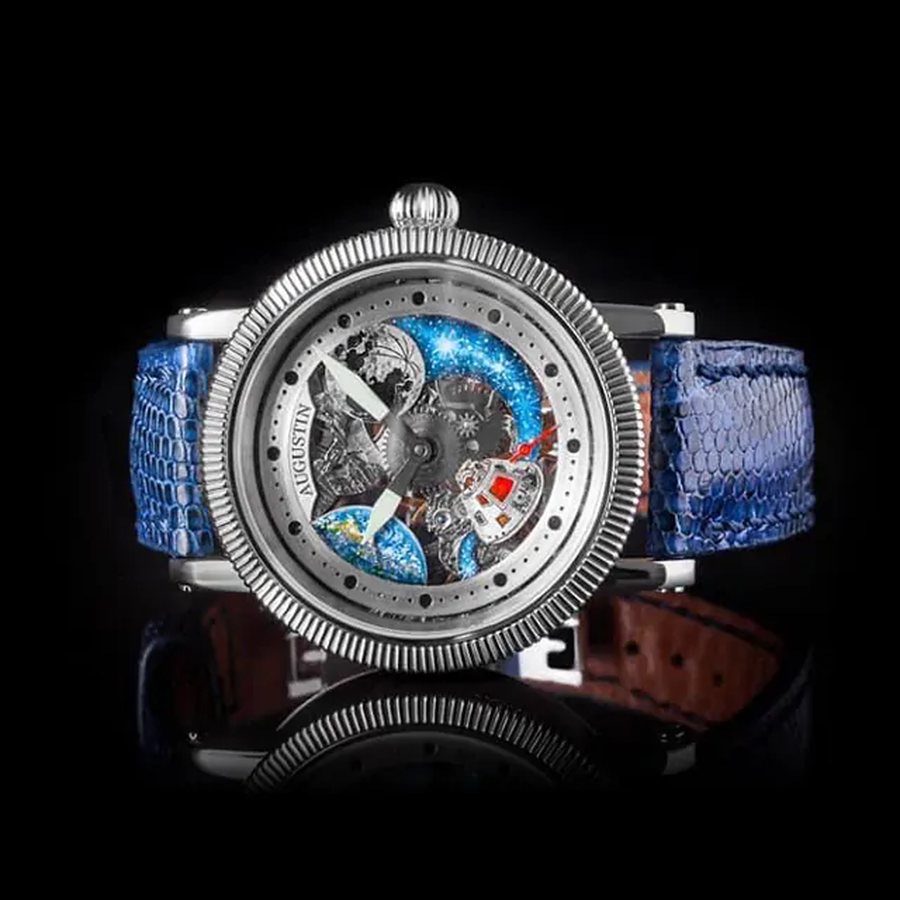
A dial that carries the Apollo 11 mission has a choice between two things.
The first is the print in the dust, or the module against black. It is recognised from three metres, asks nothing of anyone and adds nothing to what the viewer already knows. It is an image consumed instantly.
The second is the moment when it could all have stopped. It has no form of its own: there is no photograph of alarm 1202. It has to be built out of something else, out of the rhythm of the numerals, out of what is shown and what is left in shadow, out of what is read only on second looking.
What a dial asks of the person wearing it
The second choice has a cost. It asks the man who wears the piece to know what he is looking at; otherwise the composition stays a handsome surface and nothing more.
On silver, worked in micro-painting and hand engraving, the choice shows in the distribution of weight: what is pressed and what is allowed to fade. Whoever knows the story finds the order. Whoever does not know it sees a dial in no hurry to explain itself.
The crew came back with 21.55 kilograms of lunar rock and soil. That figure fits on a dial. The second in which it was decided that the alarm would not stop the descent does not fit; it is suggested.
Sources for this text: NASA, the Apollo 11 mission journal.